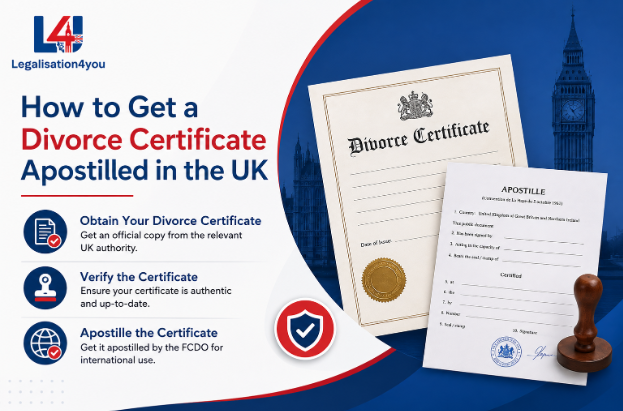
How to Get a Divorce Certificate Apostilled in the UK
When a divorce certificate needs to be used outside the UK, it may require additional authentication before it can be accepted by a foreign authority. Depending on the destination country and the purpose of the document, this may involve an apostille, certification, translation, or further legalisation.
Whether you are planning to remarry abroad, applying for a visa, dealing with international family matters, or completing an overseas legal process, understanding the requirements can help you avoid unnecessary delays.
Legalisation4you provides professional support for individuals and businesses dealing with apostille, certification, translation, and document legalisation requirements. Professional guidance can make the process of preparing UK documents for international use more straightforward.
This guide explains what a divorce certificate apostille is, when you may need one, and how the process generally works in the UK.
What Is a Divorce Certificate?
A divorce certificate is an official document confirming that a marriage has legally ended. It may be required when dealing with government departments, courts, immigration authorities, marriage authorities, or other organisations.
When a UK divorce document needs to be presented to an authority overseas, the receiving organisation may want confirmation that the document is genuine. An apostille can provide this authentication when the destination country accepts documents under the Hague Apostille Convention.
Before arranging an apostille, it is important to confirm which divorce document the overseas authority requires.
What Is an Apostille?
An apostille is an official certificate used to authenticate certain public documents for use in countries that recognise the Hague Apostille Convention.
It confirms the authenticity of a signature, seal, or stamp on the document. An apostille does not verify the information contained within the document itself.
If an overseas authority requests an apostilled divorce certificate, the apostille helps demonstrate that the UK document has been properly authenticated for international use.
The exact requirements can vary depending on the country where the document will be presented.
When Might a Divorce Certificate Need an Apostille?
There are several situations where an apostilled divorce certificate may be requested.
Getting Married Abroad
People who have previously been married may need to provide evidence that their previous marriage has legally ended when planning to marry in another country. The relevant foreign authority may request an apostilled divorce certificate as part of its marriage requirements.
Immigration and Visa Applications
Some immigration authorities require documents showing an applicant’s previous marital status. If the documents are being submitted to a foreign government, an apostille may be required.
International Legal Matters
A divorce certificate may also be required for overseas family, inheritance, property, or court-related matters. Authentication can help the receiving authority verify the document’s origin.
Other Official Procedures
Foreign government departments, institutions, or organisations may request authenticated UK documents for administrative purposes. Always check the requirements of the organisation receiving your document before beginning the process.
How to Get a Divorce Certificate Apostilled in the UK
The exact process depends on the document and destination country, but these general steps can help.
1. Obtain the Correct Divorce Document
First, make sure you have the correct official document requested by the overseas authority.
Not every document connected with divorce will necessarily follow the same authentication procedure. Confirm whether the authority requires a specific certificate or court document.
2. Check the Destination Country’s Requirements
Requirements differ between countries. Some authorities may only require an apostille, while others may also require certification, translation, or embassy legalisation.
Checking these requirements before submitting your documents can help prevent unnecessary costs and delays.
3. Check Whether Certification Is Necessary
Certain documents may require certification or notarisation before they can be apostilled. The correct procedure depends on the type and source of the document.
If you are unsure about the requirements, professional document legalisation support can help you identify the appropriate steps.
4. Arrange the Apostille
Once the document is suitable for processing, it can be submitted through the appropriate UK apostille process.
The apostille authenticates the relevant signature, seal, or stamp so the document can be used in a country that recognises the apostille system.
5. Arrange Translation if Required
If the destination authority does not accept documents in English, you may need a professional translation.
Some authorities may require a certified translation or specify how translated documents should be prepared. Check these requirements before arranging the translation.
6. Complete Further Legalisation if Required
An apostille may not always be the final step. Certain countries or authorities may require additional embassy or consular legalisation.
The requirements depend on where and why the divorce document will be used.
Common Mistakes to Avoid
Preparing documents for international use can become complicated if requirements are not checked in advance.
Common mistakes include:
- Using the wrong divorce document
- Failing to check the destination country’s requirements
- Assuming every country accepts an apostille in the same way
- Arranging translation too late
- Assuming an apostille automatically satisfies embassy requirements
- Providing an unsuitable document or copy
- Waiting until the last minute to prepare paperwork
Checking the requirements before starting the process can help reduce the risk of delays or rejected documents.
Apostille, Certification and Legalisation: What Is the Difference?
These terms describe different processes and should not always be treated as interchangeable.
Certification may involve confirming that a document or copy has been properly certified by an authorised professional.
An apostille authenticates a qualifying signature, seal, or stamp on a UK public document for use in countries that recognise the Hague Apostille Convention.
Legalisation refers more broadly to the authentication process required for documents intended for use overseas. Depending on the destination country, this may involve an apostille and potentially further embassy or consular procedures.
Understanding the difference can help you determine which services your divorce certificate actually requires.
Can a Divorce Certificate Be Translated?
Yes, a translation may be required if the overseas authority does not accept documents in English. The receiving organisation may specify whether the translation needs to be certified or completed according to particular standards.
Translation and apostille requirements should be checked together because the appropriate process can depend on the destination country and the way the document will be used.
Why Choose Legalisation4you?
Legalisation4you provides professional UK apostille services for individuals and businesses dealing with document authentication, certification, translation, and legalisation requirements.
Our support covers personal, legal, educational, and commercial documents intended for use in the UK and overseas.
Clients can benefit from:
- Divorce certificate apostille support
- Document certification assistance
- Translation support
- Apostille and legalisation guidance
- Assistance with personal and legal documents
- Support with international document requirements
Professional assistance can make the process easier, particularly when you are unsure whether your documents require certification, translation, apostille, or additional legalisation.
Is an Apostille Always Required for a Divorce Certificate?
No. An apostille is only required when the relevant country or receiving authority requests authentication and the apostille process is applicable.
Some organisations may accept the original UK document without further authentication, while others may require an apostille or additional legalisation.
For this reason, always check the requirements of the relevant foreign authority before arranging services.
Get Your Divorce Certificate Ready for International Use
Using a UK divorce certificate overseas may require more than simply presenting the original document. Depending on the destination country and purpose, you may need an apostille, certification, translation, or further legalisation.
Understanding the requirements in advance can help prevent delays and ensure your paperwork is prepared appropriately.
Legalisation4you provides professional support with apostille, translation, certification, and document legalisation services for individuals and businesses.
If you need assistance preparing a divorce certificate for international use, contact Legalisation4you to discuss your requirements.
Frequently Asked Questions
1. What is a divorce certificate apostille?
A divorce certificate apostille is an authentication attached to an eligible UK document for use in countries that recognise the Hague Apostille Convention.
2. Does every divorce certificate need an apostille?
No. The requirement depends on the country and organisation where the document will be used.
3. Can I use a UK divorce certificate abroad?
Yes, but the receiving authority may require an apostille, translation, certification, or additional legalisation.
4. Will I need to translate my divorce certificate?
This depends on the requirements of the destination authority. Some organisations may require a certified translation.
5. Can Legalisation4you help with a divorce certificate?
Yes. Legalisation4you provides professional support with apostille, certification, translation, and legalisation requirements for UK documents intended for international use.