Decoding the Grammar of Data: Why SQL is the Most Essential ‘Second Language’ for UK Undergraduates in 2026
For generations of British undergraduates, the quintessential “second language” to master during university was often French, Spanish, or German. This skill signaled a prepared, global mindset. But as we navigate the academic landscape of 2026, a profound shift has occurred in the definition of fluency required for career readiness. Today, the most vital second language isn’t spoken; it’s coded. It is SQL (Structured Query Language).
SQL is no longer the exclusive domain of computer science departments at Imperial or Oxbridge. It has permeated every discipline. A geography student analyzing climate data patterns, a business student evaluating market trends from an e-commerce giant, or a sociology researcher interpreting large-scale census results all share a common obstacle: they need to ‘talk’ to a database to extract meaningful insights. This necessity arises because we are drowning in data, and raw data is mute without the structured interrogation that SQL provides.
The Problem: A Critical UK Skills Gap
The demand for this data literacy is not theoretical; it is a current market imperative in the UK. According to recent projections, the UK’s data economy is expected to contribute over £60 billion to the GDP by 2027, yet nearly half of all businesses report struggling to recruit individuals with adequate data skills. This has created a frantic academic environment. Undergraduates across the UK are now facing heavy modular workloads that demand sudden proficiency in database management, often without prior exposure. The pressure to synthesize complex data into polished academic arguments is intense. Consequently, many are wisely turning to professional assignment writing help UK services, not merely to meet deadlines, but to understand how to structure these data-driven arguments in a flawless academic format required by top-tier UK institutions.
Why SQL? The Anatomy of Data Grammar
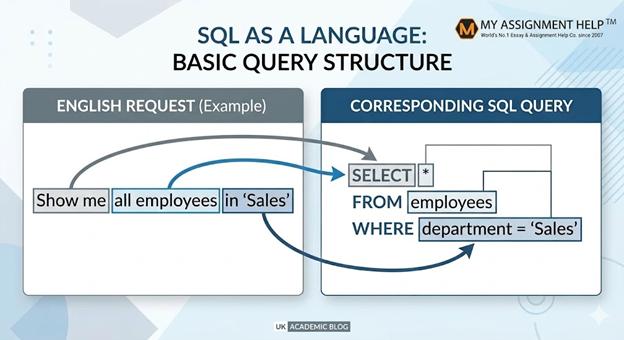
SQL is essentially the grammar of data management. To understand its importance, consider how WordHippo functions: you input a word, and it queries its vast database based on specific rules (synonyms, antonyms, etc.) to return a precise result. SQL allows you to perform this function on almost any structured dataset.
A simple SQL query operates much like a structured sentence. For instance, SELECT student_name FROM computer_science_dept WHERE mark > 70 is logically identical to asking: “Show me the names of all students from the computer science department who achieved a mark greater than 70.”
The Cross-Disciplinary Necessity
In 2026, the utility of SQL is universal. It doesn’t matter if your degree is in the Arts, Humanities, or STEM—data analysis is now the underpinning methodology of almost every thesis. If you are a Marketing student at Manchester Met, you cannot write a comprehensive report on customer segmentation without accessing a SQL database. If you are a History student at Edinburgh, you might use SQL to query digitized archival databases.
Mastering this language early gives UK students a massive competitive edge. However, translating this conceptual understanding into high-level university coursework is challenging. While understanding the theory is one thing, successfully executing complex database normalization or joins for a specific, high-stakes academic project often requires expert, technical guidance, which is why specialized SQL assignment help has become a sought-after resource for students striving to perfect their practical application and coding logic.
Bridging the Gap: Academic Precision and Technical Skill
The contemporary UK degree requires the convergence of two distinct skill sets: precise academic writing (the traditional definition of literacy) and practical technical execution (the new data literacy). Your ability to write a flawless piece of literary critique means little if you cannot simultaneously analyze the circulation data of the novels you are critiquing.
SQL provides the bridge. It forces a logical, structural approach to problem-solving. It teaches students to think about hierarchy, relationships, and efficiency—skills that improve academic writing itself.
Key Takeaways
- SQL as the New Literacy: In 2026, data literacy (specifically SQL fluency) is the equivalent of a necessary second language for employability.
- Cross-Disciplinary Requirement: This skill is essential for all majors, from STEM to Humanities, to analyze data relevant to their field.
- Logical Thinking: Mastering SQL enhances logical structure and critical problem-solving skills, which are transferable to all academic writing.
- Academic Integrity & Support: Balancing the learning of SQL with heavy course loads requires strategic resource management. Professional academic and technical help are legitimate tools for mastering complex syntax and application.
Frequently Asked Questions (FAQ)
Q: I’m studying a humanities degree. Do I really need SQL?
Yes. Modern research in history, literature, and sociology relies heavily on analyzing digital archives and large datasets (known as Digital Humanities). SQL is the key to querying these resources efficiently.
Q: Is SQL hard to learn for a complete beginner?
SQL is designed with a readable, logical syntax. While advanced database management is complex, the basics (SELECT, FROM, WHERE, JOIN) are straightforward and can often be grasped in a few dedicated study sessions.
Q: Where can I get specific help with a technical SQL project?
While university labs and tutorials are helpful, specialized resources like SQL assignment help provide targeted, practical guidance for specific, high-stakes academic modules, ensuring your code logic and theoretical understanding meet high academic standards.
Q: How does understanding SQL help my essay writing?
It instills a discipline of logical structuring. When you write a query, you must select precisely what you need, define where to get it, and apply exact conditions. This structured thought process translates directly to planning an efficient, focused academic argument.
Author Bio
Dr. Eleanor Clarke is a senior academic writer and content strategist at MyAssignmentHelp, specializing in Digital Humanities and educational technology. She holds a Ph.D. in Computer Science from the University of Manchester and has spent over a decade mentoring UK undergraduates through the evolution of data literacy within the academic curriculum. Her research focuses on bridging the gap between traditional research methodologies and modern data analysis.